
Government programmes can build infrastructure and provide services, but real change happens only when people understand them, believe in them and become part of them. That is the power of Information, Education and Communication.
There are some lessons we learn as children that stay with us for life. Keeping ourselves clean, washing our hands and respecting our surroundings are among them. Over time, however, many of these habits take a back seat. Then came COVID-19. Suddenly, the world was reminded of the importance of hygiene, cleanliness and public health.
The pandemic taught us a simple lesson: knowing what is right and actually practising it are two different things. Between the two lies the need for awareness, understanding and consistent communication.
This brings us to three letters that have been part of government programmes for years but perhaps do not receive the attention they deserve: IEC — Information, Education and Communication.
IEC is often associated with posters, pamphlets, advertisements and awareness campaigns. But its purpose goes much deeper. Information tells people what they need to know. Education helps them understand why it matters. Communication makes them relate to the message and encourages them to act.
Take waste management. Telling people not to throw garbage on the road is information. Explaining its impact on health and the environment is education. Working with households, schools and neighbourhoods to encourage waste segregation is communication.
The success of IEC is not about how many people have seen a message. It is about how many people have actually changed something in their lives because of it.
Beyond advertisements: Understanding people first- One of the biggest challenges facing governments is not always the absence of good policies or development programmes. It is ensuring that these initiatives translate into meaningful change on the ground.
A sanitation programme cannot succeed unless households change their habits. Healthcare initiatives need people to understand the importance of prevention. Welfare schemes can only benefit citizens if they know about them and understand how to access them.
This requires communication to go beyond publicity. It means understanding people’s habits, concerns, languages and local realities before deciding what to tell them.
Concept Communication Ltd (CCL), one of India’s leading independent integrated communication agencies, recognised the importance of this approach and has steadily built experience in the IEC space through its work with government departments across different states.
Its experiences in Kerala, Odisha and Goa offer interesting examples of how communication can become an instrument of public participation and social change.
The new power of influencers: The way people receive information has changed dramatically. Newspapers, television and radio continue to matter, but social media has introduced a new dimension to public communication.
People increasingly follow individuals they recognise, trust and relate to. These could be doctors, teachers, film personalities, travel bloggers or local content creators.
This creates an important opportunity for IEC: A doctor explaining preventive healthcare, a local influencer demonstrating waste segregation or a travel creator encouraging responsible tourism can sometimes make a stronger connection than a conventional advertisement.
The opportunity is not restricted to celebrities with millions of followers. Regional influencers and micro-creators can often have a much closer relationship with their audiences. A familiar voice speaking in a local language about a local issue can be particularly effective.
However, influencer engagement must go beyond celebrity endorsements. Credibility, subject knowledge and audience relevance are equally important. The objective should be to use these voices to simplify information, address misconceptions and encourage meaningful participation.
The real value of an influencer is not the number of followers but the ability to make people listen, relate and respond. For communication agencies, this means combining the credibility of government institutions with the human connection of voices that people already trust.
Kerala: Making every household part of the solution- The Kerala Solid Waste Management Project, supported by the World Bank and implemented by the Government of Kerala, aims to strengthen waste management across 87 municipalities and six municipal corporations.
But waste management is not just about collection and infrastructure. It begins inside our homes.
Do people separate wet and dry waste? Do they understand the consequences of improper disposal? What prevents them from adopting better practices? CCL approached this challenge by first understanding public attitudes and communication needs. Its research engaged households, sanitation workers, service providers, local representatives and businesses to identify behavioural barriers and public concerns.
The resulting communication programme brought together mass media, local campaigns and community engagement. Popular Malayalam film personalities, including Mohanlal, Mammootty and Manju Warrier, helped take the message to a wider audience.
Children and young people were also encouraged to participate, while the five Rs — Refuse, Reduce, Reuse, Repurpose and Recycle — helped make responsible waste management easier to understand. The message was simple: a cleaner Kerala cannot be created by the government alone. It must begin with every household.
Odisha: Taking development to the villages, one conversation at a time One of the important challenges in government communication is helping people understand a change that directly affects their lives. Concept Communication Ltd faced this challenge while working on an awareness campaign for the Cuttack Development Authority (CDA) in Odisha.
The expansion of CDA’s administrative area to include newly incorporated villages brought new development opportunities. The Authority’s objectives included planned development, better civic facilities, water and sewage services, and housing for the economically weaker sections.
However, the change also raised concerns among villagers. Many feared that coming under CDA would mean more paperwork, longer procedures and additional layers of administration. There was a need to address these apprehensions and help people understand what the change meant for their villages.
Concept Communication Ltd recognised that simply issuing announcements or distributing information would not be enough. The villagers needed to be reached directly, their concerns had to be addressed, and the purpose of the initiative had to be explained in a language and manner they could understand.
The campaign was built around two simple ideas: Development and Empowerment. To take the message to the people, the agency adopted a mix of traditional and on-ground communication methods. Tin-plate branding was used across villages to keep the message visible in everyday surroundings. Booklets helped explain the objectives of CDA and its role in planned development.
A mobile exhibition was another important part of the campaign. Instead of expecting villagers to visit an office to understand the initiative, the information was taken to their doorsteps. The mobile exhibition travelled through different locations, allowing residents to see, learn and understand the development plans.
Information kiosks created opportunities for people to engage with the campaign, while street plays, or nukkad nataks, used familiar forms of local performance to explain the message. These performances made the subject easier to understand and encouraged people to connect with the initiative.
The strength of the campaign lay in taking communication out of government offices and into the villages. It used familiar formats, local engagement and direct interaction to make an important government initiative more accessible to ordinary people.
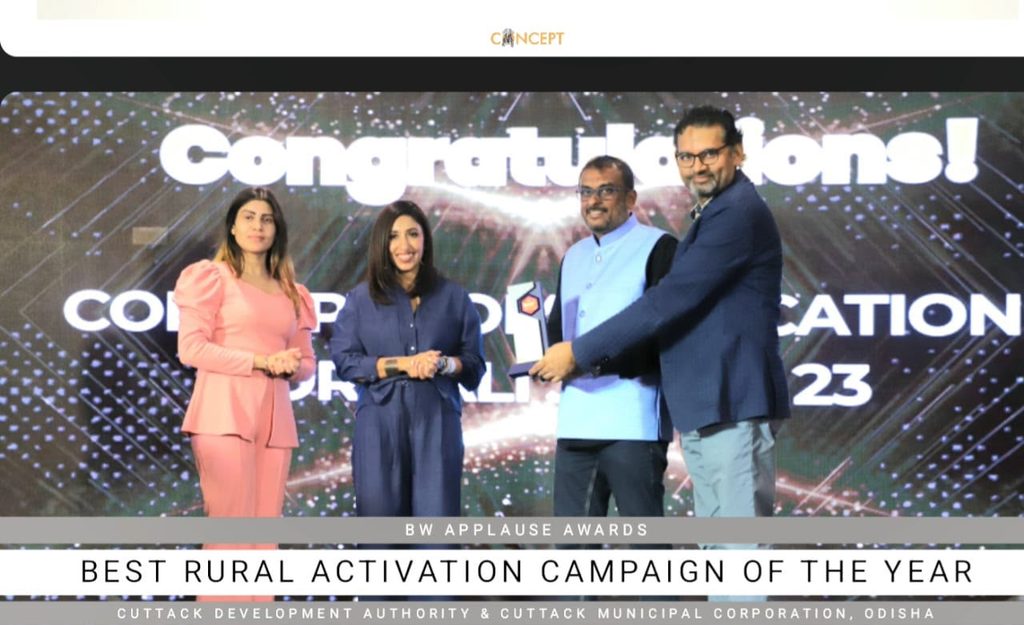
The campaign also received recognition at the BW Applause Awards, winning the Best Rural Activation Campaign of the Year for the Cuttack Development Authority and Cuttack Municipal Corporation, Odisha.
The larger lesson from this initiative is that development is not only about making plans or creating facilities. People must understand the changes taking place around them and feel included in the process. Communication plays an important role in building that understanding and trust.
Goa: Telling a different story about tourism- Goa offers another interesting example of communication supporting a larger development vision. For years, Goa has been identified largely with its beaches and nightlife. But the state has much more to offer — its spiritual heritage, temples, churches, villages, traditions and hinterland.
When Concept Communication Ltd came on board with the Department of Tourism, Government of Goa, in December 2023, the challenge was to give meaning to the idea of Goa Beyond Beaches.
The approach went beyond conventional tourism advertising and focused on Regenerative Tourism — an approach that encourages visitors to respect the environment, support local communities and help preserve cultural heritage. In January 2024, Goa presented its regenerative tourism vision, positioning itself as India’s first state to launch this approach.
Initiatives such as Ekadasha Teertha, a proposed circuit connecting eleven spiritual destinations, brought attention to Goa’s spiritual heritage. Homestays and hinterland tourism were also promoted to encourage visitors to discover village life and create opportunities for local communities, particularly women and young people.
Between January 9 and 11, 2024, journalists from different cities were invited to experience this wider tourism narrative through visits to the Basilica of Bom Jesus, cycling experiences, homestays and destinations such as Tambdi Surla and Mangeshi temples.
Influencers and travel creators offer an additional opportunity to take this story to wider audiences, showing visitors a side of Goa they may never have experienced and encouraging more responsible travel.
The experience demonstrates that communication can do more than promote a destination. It can help shape how tourism develops and how its benefits reach local communities.
The changing role of communication agencies- These experiences show that IEC is not restricted to sanitation or public health. It can support education, road safety, tourism, environmental protection, women empowerment and almost every area of public development.
But it also changes what we expect from communication agencies. It is no longer enough to create attractive advertisements or generate impressive social media numbers. Agencies must understand the subject, spend time with people, appreciate local realities and make information useful in everyday life.
For Concept Communication Ltd, this is an important part of its integrated communication philosophy — bringing together research, strategy, creative communication, mass media, digital platforms, influencer engagement and on-ground participation.
As Vivek Suchanti, Chairman and Managing Director of Concept Communication Ltd, puts it: “At Concept, we believe communication must go beyond sharing information or creating visibility. Its real purpose is to help people understand, participate and bring about change. Government programmes can achieve their true purpose only when people become active partners in them. IEC gives us the opportunity to make that connection and create a lasting impact on society.”
“I have always believed that communication can make a real difference only when we understand the people we are speaking to. Government IEC work is not just about creating campaigns; it is about travelling to the ground, listening to people, understanding their realities and finding ways to make communication meaningful to their lives. At Concept, our work across several states has been driven by this belief. While recognition is always encouraging, the real reward is seeing communication translate into awareness, engagement and meaningful change on the ground.”
Sunil Nair Executive Director, Concept Communication Ltd. Measuring what really matters. How do we know whether an IEC campaign has worked? Not by counting the number of posters printed, advertisements released, influencers engaged or social media impressions generated.
The real questions are simpler. Has a family started separating its waste? Does a citizen know how to access a government scheme? Is a community participating in a development programme? Are visitors discovering destinations beyond the usual tourist centres?
These are the changes that matter. Governments invest enormous resources in infrastructure and development programmes. Equal attention must be given to ensuring that people understand these initiatives and become part of their success. IEC should therefore not be treated as an additional publicity exercise. It must become an integral part of planning and implementing government programmes.
The larger ambition should be to turn government schemes into people’s movements — where citizens are not merely beneficiaries but active participants in the development of their communities. Information tells us what needs to be done. Education helps us understand why. Communication brings people together to make it happen. And when people begin to take ownership, a government programme becomes a movement for social change.